Is Yoga Really 5,000 Years Old?
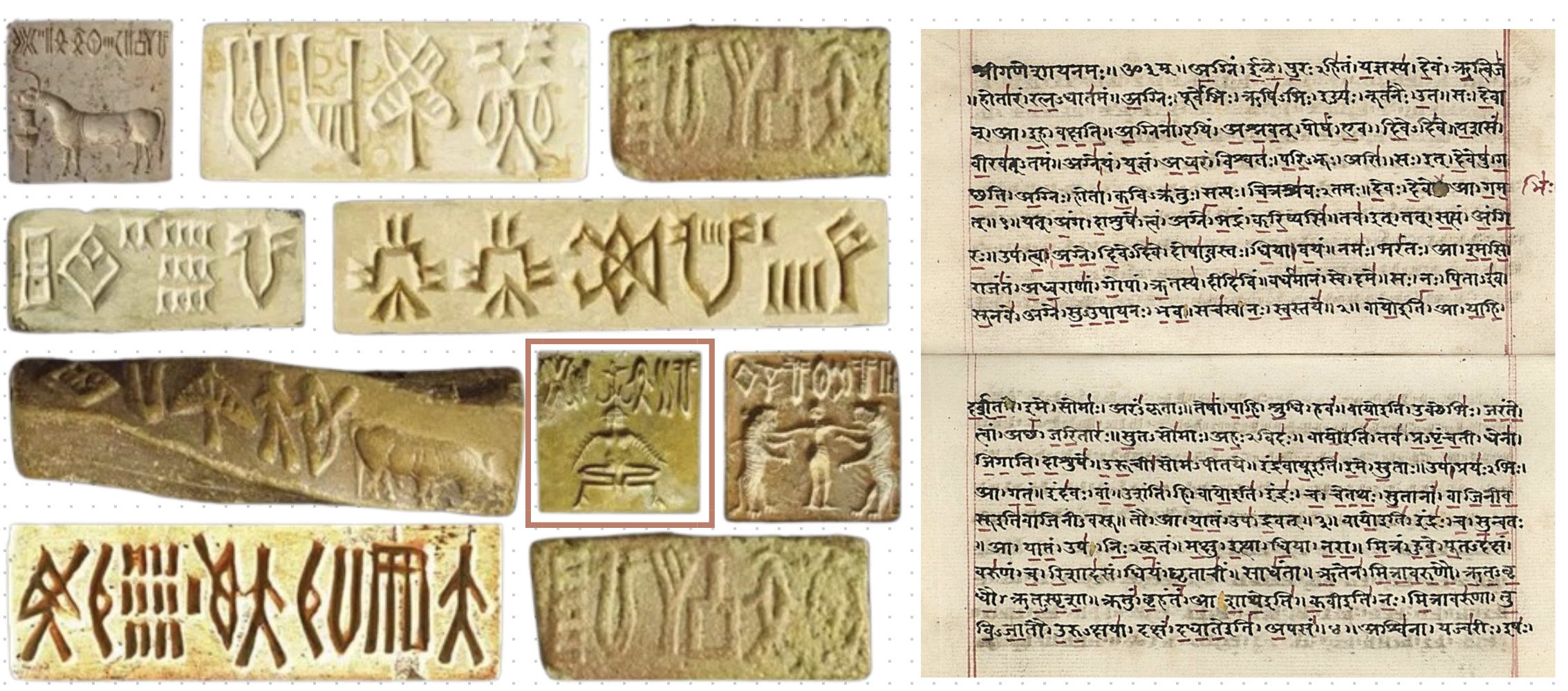
Harappan seals (with Pashupati Seal in a red square) & an early-19th-century manuscript of Rigveda
PART I OF YOGA HISTORY AND TRADITION SERIES
History is far from an exact science. Evidence is often incomplete, particularly when we are looking thousands of years into the past, and the same evidence can be interpreted in different ways. Yoga's history is no exception. But neither is it an impenetrable mystery; we do know a great deal. If we follow the available textual and archaeological evidence, we can trace how different ideas and practices emerged, changed and interacted over many centuries. We may not always be able to draw firm conclusions, but we can distinguish between what the evidence tells us, what is a reasonable interpretation, and what is largely speculation.
The problems begin when other things get in the way. Religion, colonialism, nationalism, politics and even the modern yoga industry have all influenced the stories told about yoga's past. Sometimes an appealing origin story can become so familiar that we stop asking whether the evidence actually supports it. The history of yoga is a field of continuing research and debate as well as continuous misunderstanding and misinterpretation. New texts are translated, old assumptions are questioned, and interpretations change. My own understanding has changed with them. So this series is not an attempt to present yet another definitive history of yoga. It looks at the evidence, distinguishes what we know from what we think we know, and explores why some versions of yoga's history have become so persistent. And perhaps there is no better place to begin than with a claim about its antiquity.
But What Do We Mean by "Yoga"?
Before asking how old yoga is, we need to ask another question: what exactly do we mean by yoga? Today, when most people hear the word yoga, they probably think of a predominantly physical practice involving postures, perhaps combined with breathing exercises and meditation. But historically, the word yoga has described many different systems and practices, often with very different aims.
For Patanjali, yoga centred on stilling the mind's fluctuations in pursuit of liberation. In the Bhagavad Gita, yoga could refer to paths of action, knowledge, and devotion. Tantric traditions developed elaborate practices involving mantra, visualisation, subtle bodies and the manipulation of vital energies. Medieval hatha yogis employed increasingly sophisticated techniques involving the body and breath. And the posture-centred yoga practised in studios around the world today is, in many respects, a much more recent development.
This creates an obvious problem with the statement "yoga is 5,000 years old." Which yoga? Are we saying that people were practising something resembling modern postural yoga 5,000 years ago? That they were following Patanjali's eight-limbed system? That they were practising meditation or breath control? Or simply that some of the practices and ideas which would much later become associated with yoga may have existed that long ago?
Those are all different questions, requiring very different evidence. And this is partly why dating the "origin of yoga" is so difficult. Yoga did not appear fully formed and then remain essentially unchanged for thousands of years. The word, the practices associated with it, and the traditions claiming it have all changed enormously over time. Rather than searching for a single birthday for yoga, it may be more useful to ask when particular practices, ideas and traditions that came to be called yoga first appear in the historical record.
And this is what I find problematic. Instead of talking about THE history of yoga, perhaps we should be talking about the histories of particular yogic traditions and practices. The history of devotional practices, for instance, is different from the history of asana. Meditation has its own history. In an average yoga class today, we may bring several of these strands together: asana and pranayama, largely inherited from hatha yoga traditions, alongside meditation, contemplation, chanting or devotional practices. Each has its own history, yet today we comfortably place them all under one enormous umbrella - yoga.
So perhaps the question is not simply, "When did yoga begin?" but how far back can we trace the different practices and ideas that eventually became part of what we call yoga? This is where the 5,000-year claim becomes interesting. Perhaps it reflects a slightly romantic desire to locate a single ancient beginning for something that, historically, had many beginnings. But how much evidence do we actually have for one?
A Merchant’s Seal
One of the most frequently cited pieces of evidence is the so-called Pashupati Seal, a small carved seal discovered at the Indus Valley site of Mohenjo-daro in the 1920s and dating to approximately 2500 BCE. The seal depicts a seated, possibly horned figure surrounded by animals. Early archaeologists interpreted the figure as a deity sitting in a yogic posture, and some identified it as a possible precursor (because this was pre-Hinduism) of the Hindu god Shiva. Since Shiva later became closely associated with yoga, the image appeared to offer compelling evidence that yoga was already being practised more than 4,000 years ago.
But the truth is, this is all theoretical; we do not actually know what the image represents. Many Harappan seals appear to have served administrative or commercial functions, although their precise meanings and uses remain debated. Indus seals have been found at Mesopotamian sites, providing archaeological evidence of the well-established trade between the two civilisations. Seals were used in commercial and administrative contexts, including identifying and sealing goods.
More importantly, the Indus script remains undeciphered. We therefore have no accompanying textual evidence telling us who the figure is, what the posture signifies, or whether it has anything whatsoever to do with yoga. A yogic interpretation is possible, but so are others, and at present none can be proved. The seal is fascinating evidence of the Indus civilisation, but it is not firm evidence that any form of yoga was being practised there. And just a small digression here, the Indus civilisation was very advanced and interesting. If you know nothing about it, it’s worth spending some time exploring it.
Yoga in The Vedas
The Vedas provide another important part of the argument for yoga's great antiquity. But it is often unclear which Vedas are being discussed - early Vedas or later texts. The earliest layers of Vedic literature date to the second millennium BCE and are therefore extremely ancient, though not old enough on their own to establish a 5,000-year history of yoga. Their primary concerns include sacrifice, cosmology, hymns to deities and the correct performance of ritual. They do not present a systematic discipline recognisable as the yoga described in later Indian texts.
That does not mean early Vedic culture contains nothing relevant to yoga. The Rigveda contains intriguing descriptions of figures such as the long-haired muni of the Kesin hymn, who appears to represent some form of ecstatic or ascetic practitioner. The concept of tapas, literally meaning “heat”, already appears in late hymns of the Rigveda, where it is associated with creative power, generation and the potency of seers. In later Vedic literature, it becomes increasingly associated with disciplined ascetic practice and the spiritual power it produces.
Later Vedic material contains further possible antecedents. Scholars have identified passages concerning asceticism, visionary experience, breath and bodily practices which may represent part of the prehistory from which later yoga developed.
The evidence becomes considerably clearer in the later Vedic and early Upanishadic period. The first clear reference to yoga as a recognisable practice appears in the Katha Upanishad, which scholars date to roughly 2,500 years ago. Katha Upanishad takes the form of a dialogue between Yama, the lord of death, and a young boy named Nachiketa. In this text, Yama describes yoga in a way that begins to resemble a structured inner discipline:
"That they consider as Yoga, the firm holding back of the senses.
Then one becomes undistracted, for Yoga comes and goes."
(Katha Upanishad 2.6, Max Müller translation)
The Upanishads do not exist in isolation, however. They emerge during a period of significant cultural change in ancient India, and many scholars see clear influence from the broader culture of renunciation developing at the time - wandering ascetics, early Buddhists, Jains - in the growing emphasis on meditation, sensory restraint, and liberation from rebirth. I'll discuss these traditions in the 2nd part of this series.
So, Is Yoga Really 5,000 Years Old?
The claim that yoga is 5,000 years old has been repeated so often that it has come to dominate the popular narrative of yoga's origins. Perhaps part of the reason is that we tend to value things we believe to be ancient, mysterious or timeless. And we like our histories to be tidy: a clear beginning, a continuous lineage, a story that is easy to understand and repeat. The reality is usually much messier. So, is yoga 5,000 years old? We cannot confidently say that it is. The Pashupati Seal is intriguing, but we cannot know with certainty what it represents. The early Vedas contain practices and ideas that may belong to yoga's prehistory, but they do not describe an identifiable system of yoga. Clearer evidence emerges considerably later. But neither can we point to one moment and say, "This is when yoga began." Again: which yoga?
Yoga has a prehistory. Ideas about asceticism, breath, the senses, consciousness, meditation and liberation developed gradually and were brought together in different ways by different communities. What would eventually be called yoga emerged from this complicated world rather than appearing fully formed at a single point in history. Perhaps, then, asking exactly how old yoga is misses something important. The search for a single origin encourages us to imagine yoga as one tradition with one beginning and one continuous line of development. Its actual history appears to have been far more complicated - and, to me at least, far more interesting.
In the next part of A Short History of Yoga, we will enter the world of wandering renunciates, early Buddhists and Jains, where some of the practices and ideas that would shape the subsequent history of yoga come much more clearly into view.
REFERENCES
Feuerstein, G. (1998). The yoga tradition: Its history, literature, philosophy, and practice. Hohm Press.
Mallinson, J., & Singleton, M. (2017). Roots of yoga. Penguin Classics.
Olivelle, P. (1998). The early Upanisads: Annotated text and translation. Oxford University Press. https://doi.org/10.1093/oso/9780195124354.001.0001
If you want to learn more, our Yoga History and Tradition online, on-demand module is available on our Educational Platform.

Nina Vukas
Nina is the founder of Spanda Institute, Program Director and a Lead Teacher for Advanced Study Programs. She has been a Yoga practitioner since 1998, started teaching full-time in 2005, and has educated yogis on their journey toward becoming Yoga Teachers, as well as yoga teachers, since 2009. Nina is also a Yoga Therapist, Mindfulness and Meditation teacher, Somatic Psychotherapist and Psychologist with a post-graduate diploma in Applied Neuroscience.